

Intro
The Algarve is Portugal’s southern coast, a strip of golden cliffs, long sandy beaches and whitewashed towns that runs about 150 kilometres from the Spanish border to Sagres. Yet first time visitors often struggle with one question: where should we actually stay? A base in lively Albufeira gives you a very different holiday from a base in quiet Tavira, even though the two towns are barely an hour apart.
Quick Answer
For a first visit, Lagos is the best all round base. It has a walled old town, several beaches within walking distance, boat trips to Ponta da Piedade, and a train station. Families who want calm beaches and resort hotels should look at Vilamoura or Carvoeiro. Anyone chasing nightlife should stay in Albufeira. Couples who want somewhere quieter will be happier in Tavira or Carvoeiro, and surfers should head west to Sagres.
The Algarve in Three Stretches
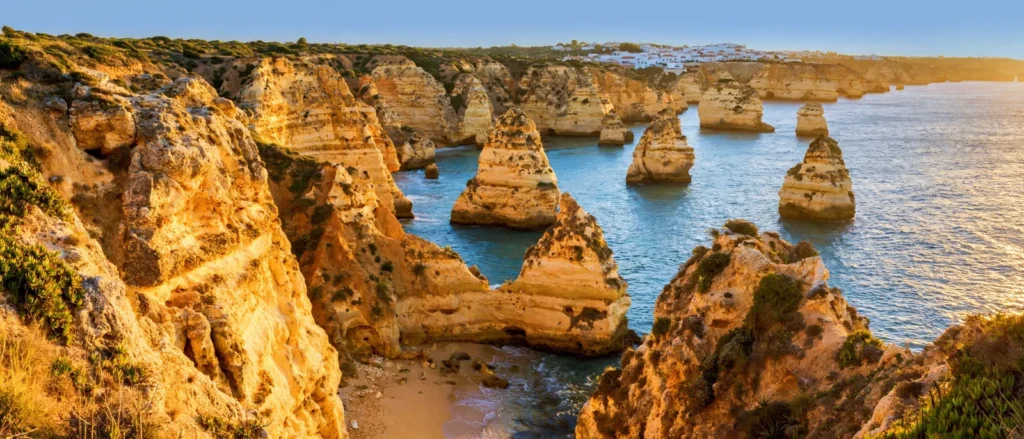
Think of the Algarve as three coasts joined together. The east runs from the Spanish border to Faro, and it is the quietest part of the region. The coast here is a lagoon, the Ria Formosa, a maze of barrier islands, salt pans and shallow water, and the towns feel properly Portuguese. The central coast, from Faro to Lagoa, holds most of the hotel beds, the golf courses and the organised nightlife. The west, from Portimao through Lagos to Sagres, is where the coastline turns dramatic, with high cliffs, sea caves and bigger Atlantic waves.
Lagos: The Best Base for a First Visit
Lagos works for more kinds of traveller than any other town on the coast. The old town sits inside its old walls, a tangle of cobbled streets, small squares, seafood restaurants and bars that stays lively without feeling like a resort strip. Several beaches sit within a short walk, from the long sands of Meia Praia to the small coves of Praia do Camilo and Praia Dona Ana. Boat trips leave the marina for Ponta da Piedade, and Lagos is the western end of the Algarve railway line, so you can arrive by train and explore on foot. If you like the idea of a walled old town by the sea, our guide to where to stay in Dubrovnik covers a similar kind of base on the Croatian coast.
Albufeira: Best for Nightlife and Choice
Albufeira is the biggest resort town on the Algarve, and it suits travellers who want plenty of choice. The old town has a lively square and a jumble of restaurants, the beaches are wide and sandy, and the Strip, a road of bars and clubs near the beach, is the region’s nightlife district. Families are well served too, with pools, kids clubs and apartments with kitchens. The trade off is scale: Albufeira is busy in July and August, and the Strip is loud late into the night, so stay in the old town if you want an early night.
Vilamoura and the Golden Triangle: Best for Golf and Resorts
Vilamoura is the polished end of the Algarve. A marina full of yachts sits at its centre, ringed by bars, restaurants and resort hotels, and the golf courses start almost at the edge of town. The Golden Triangle, the name given to the Vilamoura, Quinta do Lago and Vale do Lobo area, holds some of the best known courses in Europe. The beach is long and sandy, with calm water that suits families, and the resort setup means you can spend a whole week without moving the car. Prices run higher than in the towns either side.
Carvoeiro: Best for Couples and Quiet Cliffs
Carvoeiro is a small cliff set village between Albufeira and Portimao, and it is the prettiest base on the central coast. The village curves around a small sandy cove, with restaurants and bars on the cliff top above it. It sits close to the limestone arches and sea caves, and boat trips to the Benagil Cave leave from nearby beaches in about 20 minutes. Carvoeiro suits couples best, and families who want a calm base with a village feel rather than a resort. You will want a car, because the village is small and the best beaches are spread out along the cliffs.
Tavira: Best for a Slower, Quieter Stay
Tavira sits in the eastern Algarve, about 30 minutes east of Faro Airport, and it is the town to choose when you want the Algarve to slow down. The historic centre is tiled and graceful, with a Roman bridge, a castle and squares where locals outnumber visitors. The beach sits on Ilha de Tavira, a barrier island in the Ria Formosa lagoon, reached by a short ferry ride. The lagoon water is warmer and gentler than on the open Atlantic coast, which suits families with small children. Tavira has a station on the Algarve line, so it works without a car.
Sagres: Best for Surf and the Wild West
Sagres sits at the far southwestern tip of Portugal, where the cliffs meet the open Atlantic, and it feels like the end of the road. The wind blows harder here, the waves are bigger, and the beaches are emptier than anywhere else on the coast. Surfers come for the consistent swell, walkers come for the cliff paths of the Costa Vicentina, and Cape St Vincent is famous for its sunsets. The town is small, with a handful of restaurants and surf schools, and a car is close to essential, because Lagos is about 30 minutes away.
Faro: Best for a Short Stay or a Late Arrival
Faro is the Algarve’s capital and the town most visitors pass straight through. The airport is only a few minutes from the centre, so a late flight or an early departure is painless, and the old town inside the walls is compact and attractive. The beaches sit on barrier islands across the lagoon, reached by ferry or bus. Faro also sits on the railway line, so Lagos and Tavira are easy day trips, and rooms here are often cheaper than in the resort towns.
Staying in the Algarve Without a Car
You can enjoy the Algarve without hiring a car, but your choice of base narrows. Lagos, Tavira and Faro are the three towns to pick, because each has a station on the Algarve railway line, which runs from Lagos in the west to Vila Real de Santo Antonio on the Spanish border, stopping at Portimao, Albufeira, Faro and Tavira on the way. What you give up without a car is the freedom to reach the small cliff beaches, the inland villages and the west coast surf spots. The A22 motorway uses electronic tolls only, so ask your hire company for a toll device.
When to Go, and What It Costs
The Algarve has one of the mildest climates in Europe, with around 3,000 hours of sunshine a year. Official climate figures for Faro put average daytime highs at 16C in January and 29C in July and August, and the sea warms from about 16C in March to 21C or 22C in August and September. May, June and September are the sweet spot for most visitors, with warm days and fewer people than the school holiday peak. One cost to budget for is the tourist tax: seven councils, including Albufeira, Faro and Loule, charge about 1 to 2 euros per person per night in high season, usually capped at seven nights. For the detail on timing, our guide to the best time to visit Portugal works through the seasons month by month.
UK Practicalities: Flights, Passport and Entry Rules
Direct flights from London to Faro take about 2 hours 45 minutes. From the airport, Albufeira and Vilamoura are about 30 to 45 minutes by car, Tavira is about 30 minutes east, and Lagos is just over an hour west. On entry rules, Portugal follows Schengen rules, so your passport must have been issued less than 10 years before the day you arrive and must be valid for at least 3 months after the day you plan to leave the Schengen area. UK citizens can travel without a visa for up to 90 days in any 180 day period. The EU’s biometric Entry/Exit System is being rolled out at Schengen borders, and ETIAS, the future online travel authorisation, is not yet in force. Our guide to the ETIAS rules for UK citizens explains the current position in full.
Frequently Asked Questions
Where is the best place to stay in the Algarve for a first visit?
Lagos. It has a walled old town, several beaches in walking distance, boat trips to Ponta da Piedade, and a train station.
Which part of the Algarve is best for families?
The central coast, around Vilamoura, Carvoeiro and Albufeira. The beaches are long and sandy with gentler water, and the hotels are set up for children.
Where should couples stay in the Algarve?
Carvoeiro or Tavira. Carvoeiro has cliff top restaurants and quiet coves near the Benagil Cave boat trips. Tavira has a graceful old town, island beaches reached by ferry, and a slower pace.
Do I need a car in the Algarve?
Not if you stay in Lagos, Tavira or Faro, which all sit on the Algarve railway line, or in central Albufeira near the beach and old town. A car helps if you want to reach the small cliff beaches, the west coast surf spots, or the inland villages.
Is the Algarve expensive?
It is one of the better value beach destinations in western Europe. Rooms, meals and car hire are usually cheaper than on the French or Italian Rivieras, but July and August push prices up sharply.